Industrial Hyperspectral Imaging
What is industrial inspection?
What is industrial hyperspectral imaging?
Industrial hyperspectral imaging is an optical measurement method that combines spatial and spectral information. For every pixel in an image, a hyperspectral camera records a spectrum across many narrow and closely spaced wavelength bands. This enables the analysis of material properties that are related to chemical composition and condition. The method is based on the interaction between electromagnetic radiation and matter. Materials absorb, reflect or transmit light differently. These interactions create characteristic spectral signatures that can be used to distinguish between materials.
In industrial environments, this is especially relevant for inspection tasks where visual appearance alone is not sufficient. Materials may look identical in an RGB image, but differ in their spectral behaviour and chemical or physical material differences can determine quality, safety or process value.
Hyperspectral imaging makes these differences visible.
Table of content
What is industrial inspection?
Industrial inspection describes the systematic automated or semi-automated evaluation of products, materials or processes. The goal is to detect defects, contamination, quality differences or deviations from defined specifications.
Industrial hyperspectral imaging supports this process by adding spectral information to image-based inspection. It can detect chemical and physical differences that are often invisible to conventional cameras or human vision.
This makes hyperspectral imaging a powerful technology for applications where material purity, product safety, process stability or reliable classification are critical.
Typical industrial inspection goals include:
- detecting contamination
- identifying material differences
- separating mixed material streams
- checking material purity
- monitoring process variation
- supporting quality control
- reducing manual inspection effort
- generating reproducible measurement data
The value of hyperspectral imaging lies in the combination of spatial localisation and spectral analysis. It can show where a material difference occurs and what spectral properties are associated with it.
Why industrial hyperspectral imaging matters
Many industrial processes require fast and reliable decisions. A product or material stream often needs to be inspected without interrupting production. At the same time, quality requirements, documentation duties and regulatory expectations are increasing.
This creates a challenge for many companies.
They need inspection systems that are non-destructive, reproducible, suitable for automation and compatible with real production conditions. These systems have to be able to detect material differences beyond visible colour and be capable of delivering data that supports quality decisions.
Hyperspectral imaging addresses this challenge by measuring wavelength-dependent material behaviour. When the relevant spectral features are present in the measured wavelength range, hyperspectral imaging can help classify materials, detect defects and support industrial decision-making.
For industrial users, the decisive question is not simply whether hyperspectral imaging can acquire data. The decisive question is whether spectral data can be turned into a reliable process decision.
- Do you have questions about your specific use case? Reach out to our support team.
Typical Applications Fields
Hyperspectral imaging in recycling and waste sorting
Recycling and waste sorting are key application fields for industrial hyperspectral imaging.
In recycling, mixed material streams often contain plastics or other materials that are visually similar but chemically different. Conventional optical methods may not be sufficient to separate these materials reliably. However, for high-quality recycling, accurate material separation is essential.
In recycling applications, hyperspectral imaging can support:
- Plastic sorting & polymer identification
- Textile sorting
- Paper and wood sorting
- Organic and food waste separation
- Construction waste recycling
- Detection of contamination
- Improvement of material purity
- Reduction of sorting errors
- Automated classification of complex material streams

For companies working with recycled materials, this is not only a technical issue. Material purity directly affects product quality, process efficiency and the economic value of recyclates.
Hyperspectral imaging can also provide data that supports documentation. Information about material composition, purity levels and sorting results can help companies create more transparent quality evidence for customers, certification processes, audits or circular economy reporting.
This is particularly relevant for companies that need reliable proof of material quality and process performance.
Hyperspectral imaging in food inspection
Food industry is another important field for industrial hyperspectral imaging.
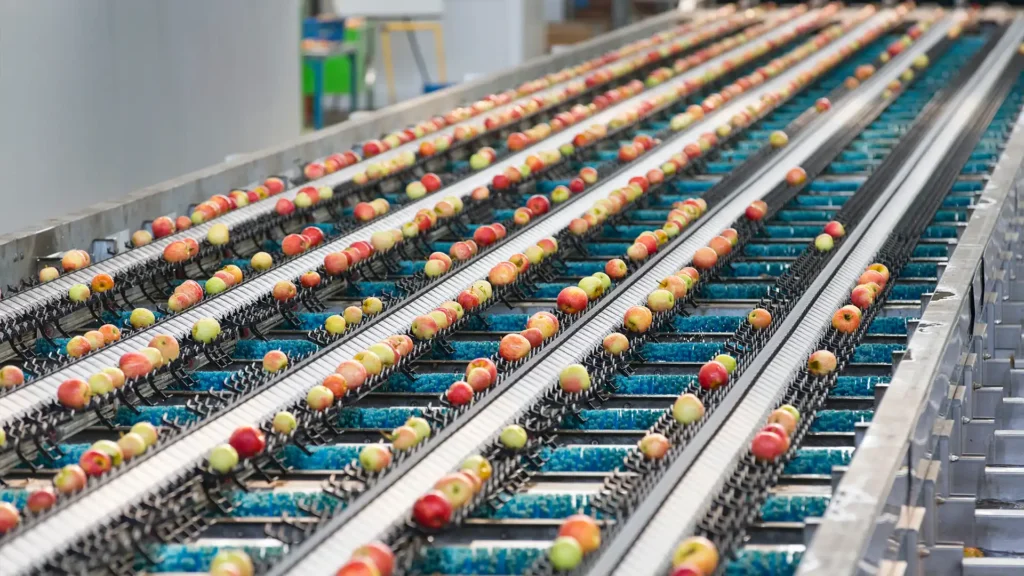
In food processing, inspection systems must often detect quality differences, contamination or foreign objects without damaging the product and without interrupting the inline production flow.
Hyperspectral imaging is well suited for non-destructive food inspection because it can provide additional spectral information beyond visible appearance.
Depending on the product and wavelength range, hyperspectral imaging can support:
- Foreign object detection
- Quality control
- Sorting by ripeness or product condition
- Moisture-related analysis
- Detection of spoilage
- Detection of damaged products
- Identification of process deviations
- Inspection of visually similar materials

Relevant products can include nuts, grains, fruit, vegetables, meat, packaging materials or processed food products.
The main benefit is risk reduction. In food production, undetected contamination or quality defects can lead to recalls, production stops, customer complaints and significant cost. Hyperspectral imaging can support more reliable quality control by detecting spectral differences that are not visible with RGB cameras or manual inspection.
And this means more data-driven basis for safety, consistency and process control.
- For more information view our application notes.
Systemintegration
Systemintegration as a key challenge
The integration of hyperspectral imaging into industrial environments is often the actual bottleneck. A hyperspectral imaging solution is not only a camera, but a complete data acquisition and decision-making system. It combines the hyperspectral sensor with spectrally suitable illumination, optics, calibration routines, mechanical setup, data processing, preprocessing, classification models and software interfaces. For industrial applications, this system must also communicate reliably with existing PLC, edge or MES environments.
This makes integration technically demanding. Inline applications require careful control of bandwidth, latency, computational load, triggering, conveyor synchronisation, acquisition speed, mechanical geometry, illumination stability and calibration repeatability. In addition, the transition from laboratory data to production-ready inline decisions must be validated under realistic process conditions.
For industrial users, this means that a hyperspectral imaging system must not only deliver accurate data. It must also be maintainable, usable and compatible with existing production environments. The challenge is therefore not only to detect a spectral difference. The real challenge is to create a robust workflow that can be implemented into a machine or process and used reliably in daily operation.
- Do you have questions about your specific use case? Reach out to our support team.
Combined technology
HAIP Solutions’ approach to industrial hyperspectral imaging
HAIP Solutions addresses integration challenges with a system-oriented approach. Instead of considering the hyperspectral camera as an isolated component, HAIP Solutions develops technology around the full workflow from data acquisition to analysis and classification.
Depending on the application, a HAIP Solutions setup can include hyperspectral cameras for VNIR, NIR and SWIR imaging, spectrally suitable illumination, calibration and acquisition workflows and BlackStudio software for spectral analysis. In addition, HAIP Solutions supports customers in evaluating industrial use cases with real samples and the development of individual hyperspectral imaging solutions that fit the customer’s workflow. Based on our experience and expertise we provide short ramp-up phases for our customer projects.
This approach is especially relevant for industrial users who first need to understand whether hyperspectral imaging can solve a specific inspection or sorting task before moving into full system integration. It reduces technical uncertainty and helps connect laboratory evaluation with practical industrial implementation.
- View all our hyperspectral imaging technology.
BlackIndustry SWIR for industrial inline applications
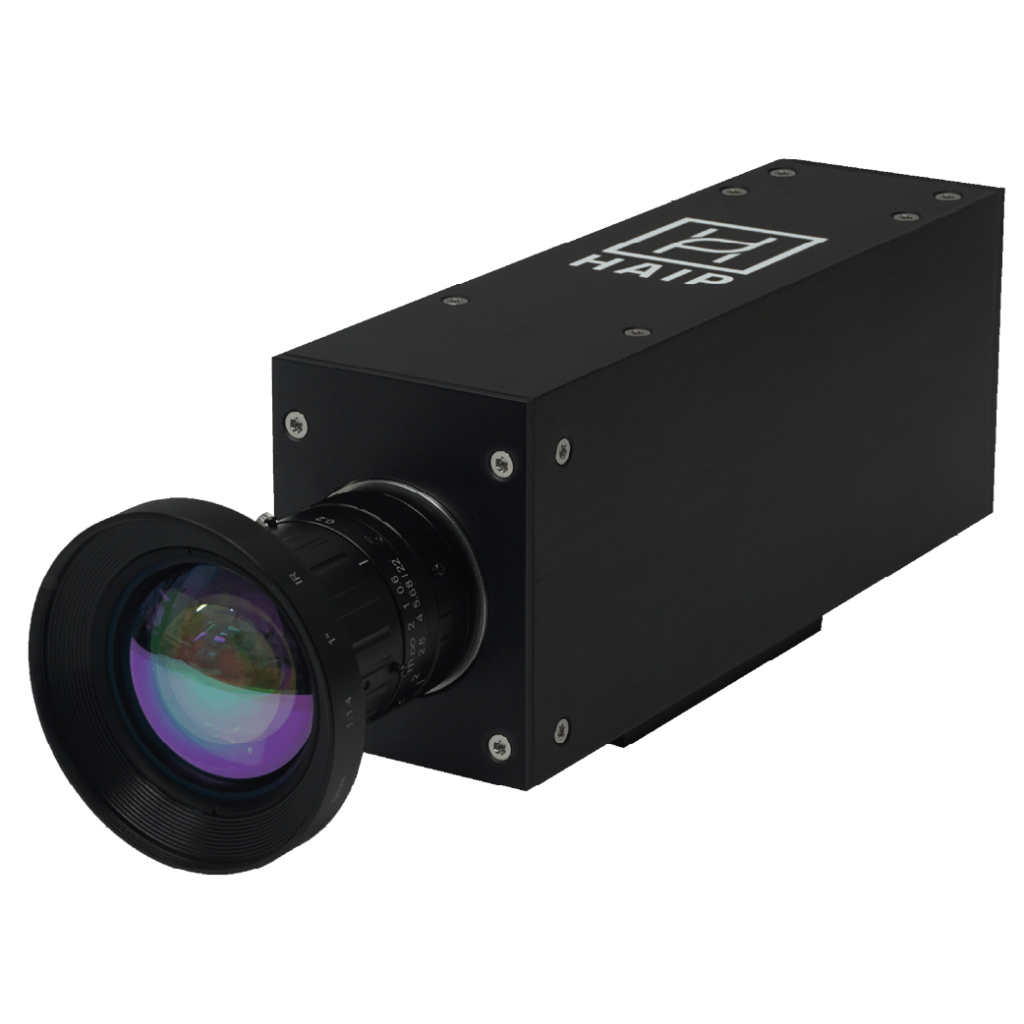
For many industrial inspection and sorting tasks, the short-wave infrared range is particularly relevant. The SWIR range can reveal material-specific absorption features that are not visible in RGB imaging. This makes it especially useful for applications such as polymer classification, food inspection, material analysis and moisture-related inspection tasks.
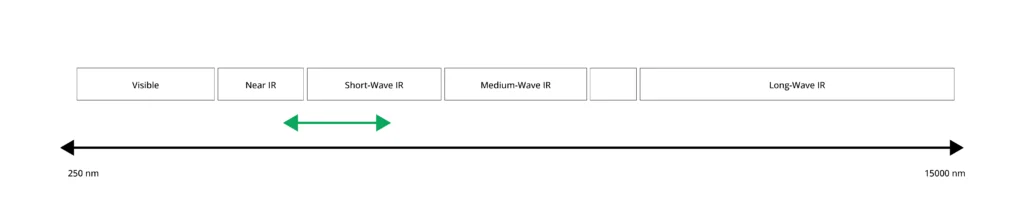
HAIP Solutions’ BlackIndustry SWIR 1.7 series is designed for hyperspectral imaging in the 950 to 1750 nm range with an outstanding sensitivity. The pushbroom principle and a framerate up to 1330 Hz in ROI Mode (or 2587 Hz with the BlackIndustry SWIR 1.7 Pro Max camera) makes the system suitable for line-scanning applications, where material moves through the measurement area. This is particularly important for conveyor-based sorting and inline inspection. For high-speed applications, region-of-interest acquisition can reduce the amount of data and support faster processing. The integrated GPU allows for on-camera data pre-processing and classification, reducing system latency and enabling real-time workflows directly at the camera.
All BlackIndustry series cameras are controllable via HAIP BlackStudio software, GenICam or a dedicated C++/Python API. Exact acquisition speeds depend on the specific camera model, configuration and measurement requirements.
BlackIndustry SWIR 1.7
- 640 px spatial resolution
- 399 spectral bands
- 450 Hz at full frame
- Up to 1330 Hz at ROI
BlackIndustry SWIR 1.7 Max
- 1280 px spatial resolution
- 399 spectral bands
- 197 Hz at full frame
- Up to 1330 Hz at ROI
BlackIndustry SWIR 1.7 Pro Max
- 2592 px spatial resolution
- 399 spectral bands
- Up to 2587 Hz at ROI
- Internal GPU
High-efficiency illumination for industrial hyperspectral imaging
Illumination is a critical part of reliable data acquisition with hyperspectral imaging, because the camera can only measure spectral information that is present in the light reaching the sensor. If the illumination does not provide sufficient intensity in the relevant wavelength range, the recorded spectra can become noisy, incomplete or difficult to reproduce. If the light distribution is unstable or inhomogeneous, the data may contain artefacts that are caused by the setup rather than by the material itself. And this is particularly important in industrial inline applications, where acquisition speed, exposure time, working distance and sample movement are often constrained by the production process.
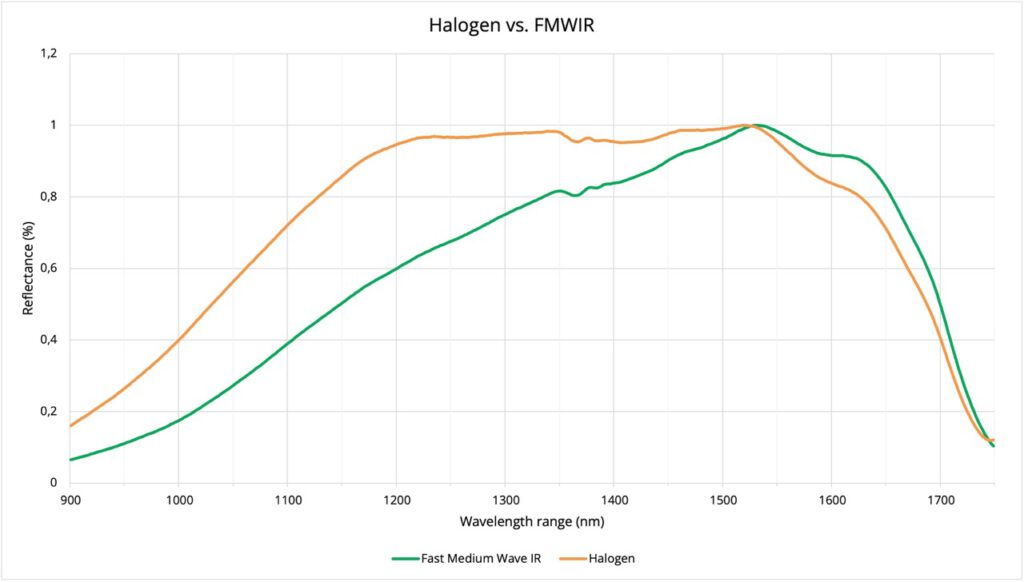
For SWIR-based inspection and sorting tasks, HAIP Solutions developed the high-efficient BlackBright FMWIR illumination. It is designed as the alternative to conventional halogen illumination and to provide stable and application-specific illumination in the short-wave infrared range. The focused and homogenous illumination line and less heat generation make the BlackBright FMWIR particularly suitable for industrial hyperspectral inspection and sorting applications where stable measurement conditions and reliable spectral data are essential.
In combination with BlackIndustry SWIR cameras, the BlackBright FMWIR supports applications such as polymer classification, material sorting, food inspection and quality control, where spectral differences in the SWIR range need to be measured reliably under practical conditions.
- Explore all technical insights.
On-camera classification for reduced integration complexity
One of the most relevant integration topics in industrial hyperspectral imaging is data handling. Hyperspectral data can be large, especially when many spectral bands are acquired at high spatial resolution and industrial speed. If all raw data must be transferred, processed and classified externally, this can increase bandwidth requirements, computational load and integration complexity.
HAIP Solutions addresses this challenge with on-camera classification. A classification model trained in BlackStudio can be transferred to the camera. Depending on the application workflow, the camera can then output classification results directly.
This can reduce Ethernet data load, external computing requirements, system complexity and latency in decision workflows. It can also reduce the amount of raw data that needs to be handled as well as high costs for computer performance. This supports the transition from hyperspectral data acquisition to process-ready output. The goal is not only to capture spectral information. The goal is to make spectral information usable for real-time inspection, sorting or quality control decisions.
Industrial hyperspectral imaging
Key takeaway
Industrial hyperspectral imaging is a powerful measurement method for non-destructive inspection, sorting and quality control. It combines spatial image information with spectral analysis and can detect material differences that are not visible in RGB images.
Its strongest industrial value lies in applications where material purity, product safety, process stability and reproducible classification are critical. This includes recycling, waste sorting, food inspection and industrial quality assurance.
For reliable results, the complete system matters. And HAIP Solutions supports this complete workflow with hyperspectral cameras, application-specific illumination, BlackStudio software and on-camera classification.
The aim is to help industrial users turn spectral information into reliable decisions for real production environments.
- Do you have questions about your specific use case? Reach out to our support team.