


Research Projects
HypReSort: Hyperspectral sorting of carbon-black-containing plastics
HypReSort
Optimiertes Kunststoffrecycling dunkler Kunststoffe durch den fusionierten Einsatz NIRS-Hyperspektralkameras // Optimised recycling of carbon-black-containing plastics through the combined use of hyperspectral cameras
Developing a sensor fusion approach for technical plastics from WEEE
Automated sorting of technical plastics becomes particularly challenging when materials contain carbon black. Carbon black strongly absorbs incident radiation in the near-infrared range and can significantly reduce the reflected signal used for polymer identification. As a result, characteristic spectral features may become too weak for reliable classification with conventional NIR-based sorting systems.
It is important to distinguish these materials from black plastics in general: a visually black appearance alone does not determine whether a polymer can be identified using NIR spectroscopy. Detectability depends, among other factors, on the pigment system, polymer composition and measurement conditions.
The research project HypReSort specifically addresses the detection and sorting of strongly absorbing dark plastics, with a particular focus on carbon-black-containing materials. Together with the Institute of Plastics and Circular Economy (IKK) at Leibniz University Hannover and TKT Kunststoff-Technik, we are developing an integrated identification and sorting approach for plastics from waste electrical and electronic equipment (WEEE).
Combining complementary hyperspectral measurements
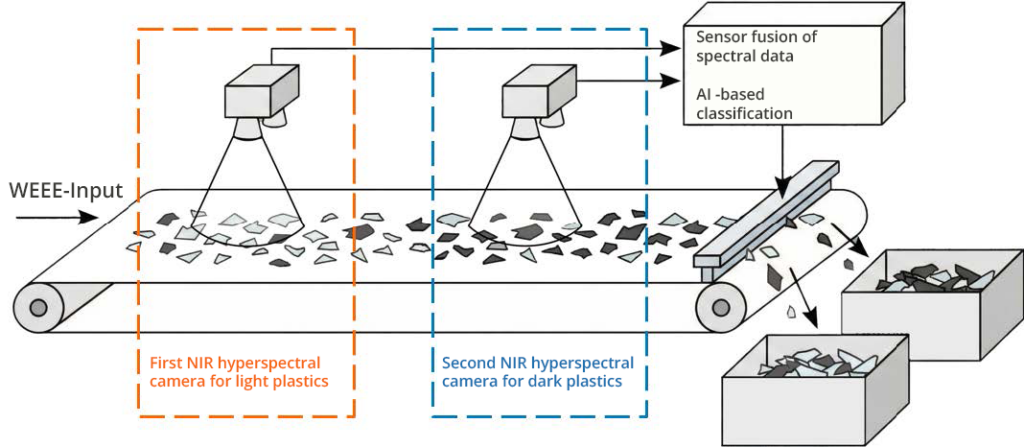
HypReSort combines two complementary detection approaches.
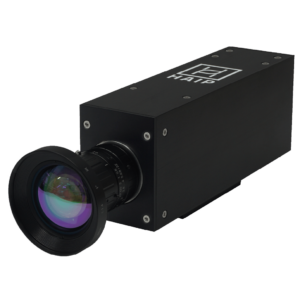
A conventional NIR hyperspectral system is used for plastics that provide sufficient spectral reflectance. In parallel, HAIP Solutions is developing a dedicated hyperspectral camera for low-reflectance, carbon-black-containing materials.
The development focuses particularly on the 1600–1750 nm region, where polymer-related spectral information may remain accessible even when the overall reflectance is strongly reduced.
The information from both cameras is subsequently combined through sensor fusion. Machine-learning methods, including neural-network-based approaches, will be investigated with the aim of enabling robust polymer classification independent of the visible colour of the material.
Towards high-quality recycling
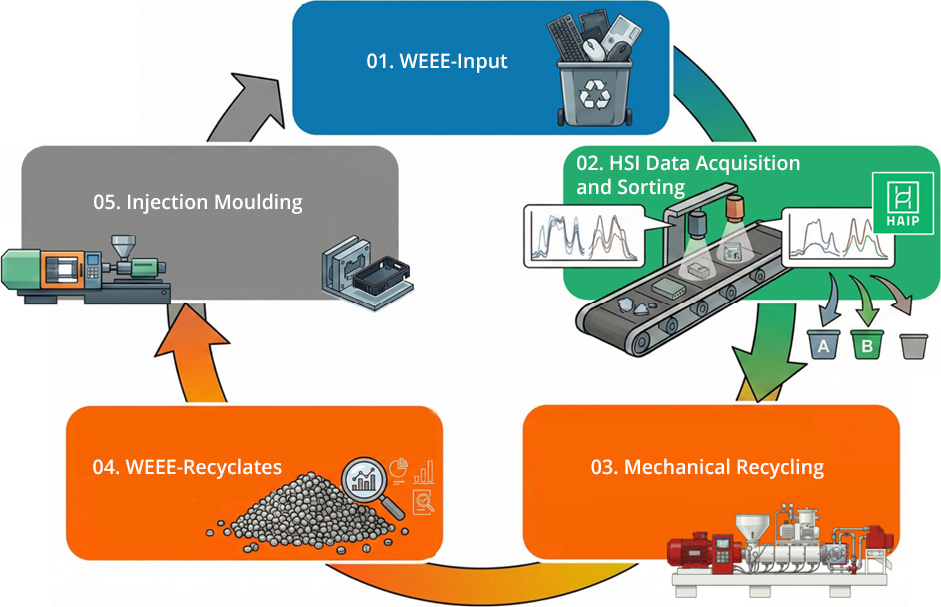
HypReSort covers more than the identification of the material. The separated polymer fractions will be processed into recyclates at the IKK and evaluated for demanding injection-moulding applications.
The objective is to enable technical plastic fractions that are currently difficult to separate to enter higher-value recycling routes and contribute to closed-loop material cycles.
The project therefore evaluates not only whether individual materials can be spectrally distinguished under controlled conditions, but also how reliably the developed approach can be transferred to more heterogeneous WEEE material streams.
HAIP Solutions' role in HypReSort
As project lead, HAIP Solutions is developing the hyperspectral detection system for strongly absorbing dark plastics, including the adapted camera and sensor configuration, illumination and optical setup, as well as the sensor fusion approach
Initial measurements with an early prototype have already shown distinguishable spectral characteristics for selected carbon-black-containing polymer samples. The ongoing project will investigate how robustly this information can be used for classification under application-relevant conditions.
Key Facts
- Project duration: 07/2026 – 06/2029
- Funding: European Regional Development Fund (ERDF / EFRE)
- Project lead: HAIP Solutions GmbH
- Project partners: Institute of Plastics and Circular Economy (IKK), TKT Kunststoff-Technik GmbH and HAIP Solutions GmbH
Technology used in HypReSort
Discover the technology
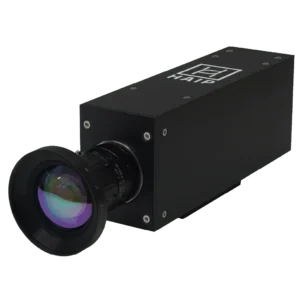
SWIR Camera
BlackIndustry SWIR 1.7 Max
Existing technology
- 1280 px spatial resolution
- 399 spectral bands
- 197 Hz at full frame
- Up to 1330 Hz at ROI
BlackIndustry SWIR 1.7 BlackPolymer
Project development
Project-specific hyperspectral camera development optimised for the low-reflectance signals of strongly absorbing, carbon-black-containing polymer materials.
Illumination
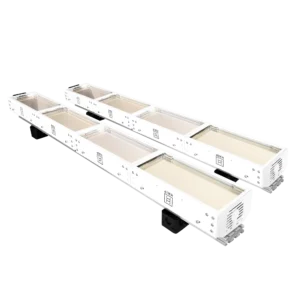
BlackBright FMWIR
Existing technology
- 900 - 1800 nm
- Double reflector setup
- Modular design (250 mm - 1000 mm)
- Long lifetime
Software
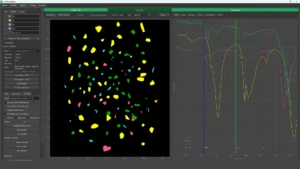
BlackStudio
Existing technology
- Hyperspectral imaging software
- For the BlackIndustry camera series
- Easy-to-use interface
- Live classification
- You have specific questions? Feel free to contact us.